NEW YORK Friday, 1 September, 1939
The steamship Wanja of Helsingborg arrived at New York immigration on 1 September 1939 after 16 days at sea. On board she has a crew of 26, 25 Swedes and 1 Norwegian.
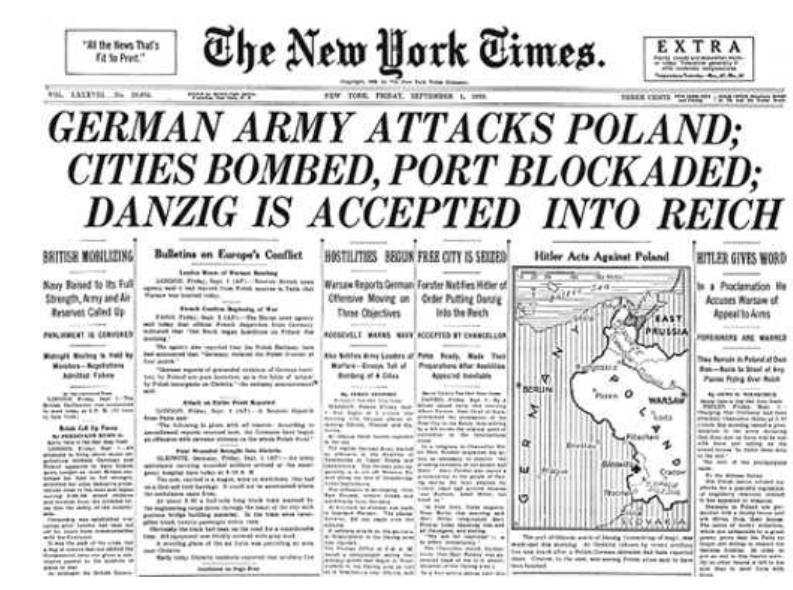
The world had changed substantially since S/S Wanja bunkered in Helsingborg on Tuesday 15 August and set course for New York. On the front page of the New York Times on September 1, large fonts read “GERMAN ARMY ATTACKS POLAND; CITIES BOMBED, PORTS BLOCKADED; DANZIG IS ACCEPTED INTO REICH”. German forces had invaded Poland and bombed Polish cities, including the capital Warsaw. The attack had occurred without any warning or declaration of war. The German invasion of Poland began at 04:44 in the morning when the German battleship SMS Schleswig-Holstein opened fire outside Danzig, which initiated the Battle of Westerplatte, the first battle in Europe during World War II. Adolf Hitler appeared in the Reichstag just after 10:00 in the morning to explain his decision. Appearing in a field grey uniform instead of his usual brown jacket, he declared that he had once again put on his soldier’s uniform and would not take it off again until victory was assured.
The newspaper headlines indicated that the situation was out of control. It was barely twenty years since blood last flowed in Europe. It was such recent history that people felt the fear of poisonous gas being dispersed by the wind. Those who had been at sea in World War I also knew the horror of torpedoes.
On Saturday 2 September, S/S Wanja sailed up the Hudson River towards the state capital Albany, where she would remain in port for 12 days before continuing her journey. While she was docked, it was decided that gas masks would be procured for everyone on board. Because one tends to prepare for the war one knows – the previous one. Several crew members on S/S Wanja had served and fought during World War I.
As S/S Wanja sailed up the Hudson River, the S/S Athenia left Liverpool. This was the last port before the crossing to Montreal, Canada. Before Captain James Cook set sail from Liverpool, he went to the Admiralty building to ask for updated sailing instructions. Athenia was to sail 30 nautical miles further north than the originally planned route.
Athenia carried a crew of 315 and 1103 passengers. Among the passengers were Jewish refugees, Canadians, Britons and over 300 American citizens.
On the evening of 3 September at 19:40 the passenger ship was between Rockall and Tory Island west of The Hebrides. The German submarine U-30 under the command of Fritz-Julius Lemp had followed Athenia for more than three hours without a conclusive identification. According to Lemp, the ship was blacked out and steering a zig-zag course that appeared to be far outside the normal ship routes. This led him to believe that she was either a troop transport, or a Q-ship. Q is short for Queenstown in Ireland, where Haulbowline Dockyard in Cork Harbour converted merchant ships into heavily armed decoy ships designed to lure submarines into surface attacks in World War I.
U-30 fired several torpedoes from about 1,500 meters. A torpedo hit Athenia on the port side by the engine room. The ship shook violently. Chaos and panic broke out when the evacuation began. Several unfortunate circumstances occurred during the evacuation and later during the rescue operation. The bottom plugs in the lifeboats had been removed during transit to allow rainwater to escape. Several of the lifeboats were launched with the bottom plugs still out.
The first ships to arrive at the scene were the Fred Olsen dry cargo ship M/S Knute Nelson and the Swedish luxury yacht Southern Cross. HMS Electra, HMS Escort and S/S City of Flint eventually arrived and took part in the rescue efforts.
Athenia remained afloat through the night, and she sank with her stern first almost 15 hours after the torpedoing. 117 people died. The City of Flint transported survivors to Halifax in Canada, while Knute Nelson landed survivors in Galway, Ireland. Families were divided and now found themselves on opposite sides of the Atlantic.
The Völkischer Beobachter, the official newspaper of the Nazi Party, published allegations that Britain sank the Athenia in an attempt to taint Germany in the conflict. It was not only in Germany that doubts were cast about what had happened. Former President of the United States Herbert Hoover also expressed doubts in the matter. 28 Americans died on Athenia. Senator in North Carolina, Robert Rice Reynolds, believed that Great Britain had a stronger motive than Germany to draw the United States into the war.
The propaganda war was on. S/S Wanja would eventually also be drawn into this propaganda war.
On Tuesday 12 September, the S/S Wanja sailed down the river and into New York Harbour bound for Florida and Boca Grande to pick up a cargo of phosphate. In the harbour she passed the ocean liners S/S Normandie and RMS Queen Mary docked side by side, unable to safely return to a Europe at war.
The World’s Fair in New York is in full swing under the slogan “The World of Tomorrow”. A white-painted troop transport ship with the American flag painted on the ship’s sides departed New York harbour on the same day as Wanja. The ship was transporting American soldiers to reinforce the Panama Canal after the outbreak of war.
In the early days of World War II, the press nicknamed it “The Phoney war” because of the lack of warfare on land. There was however nothing phoney about the war at sea. S/S Wanja and her crew were soon to experience this first-hand.
 X marks the spot