
The star of this story is the S/S Wanja. And she was first named after a bright star. She was launched as S/S Aldebaran.
Before continuing to reveal details of her fate and the aftermath, a short history of the life of S/S Wanja is in order. During her twenty year long career the S/S Wanja had three names, and carried a variety of goods between ports in North and Central America and Europe. She had engine trouble, made it through great storms, and she rescued sailors in peril. She was in Buenos Aires, Pernambuco, Rosario, New York, Lisbon, Montreal, Curacao, San Domingo, Aruba, Danzig, Gdynia, Tallin, Rotterdam, Hamburg, Liverpool, Tampa, Charleston, New Orleans, Philadelphia, Norfolk, Mobile, Frontera in Mexico, Nuevitas, Cardenas and Santiago on Cuba. She was one of the first ships to arrive in Torquay after WWI.
Her call sign was S D G A.
Typical types of cargo and routes were coal from Hampton Roads to Ireland and Great Britain, phosphate from Florida to Sweden, timber from Sweden for use in mining in Hull, England, pulp and paper from Sweden to Preston, England, sugar from Cuba, and to Boston with coal.
She saved four out of eight crew from the German scooner Clare Elise, which sank on 3 September 1932 near the Svenska Björn Lightship in the Stockholm archipelago.
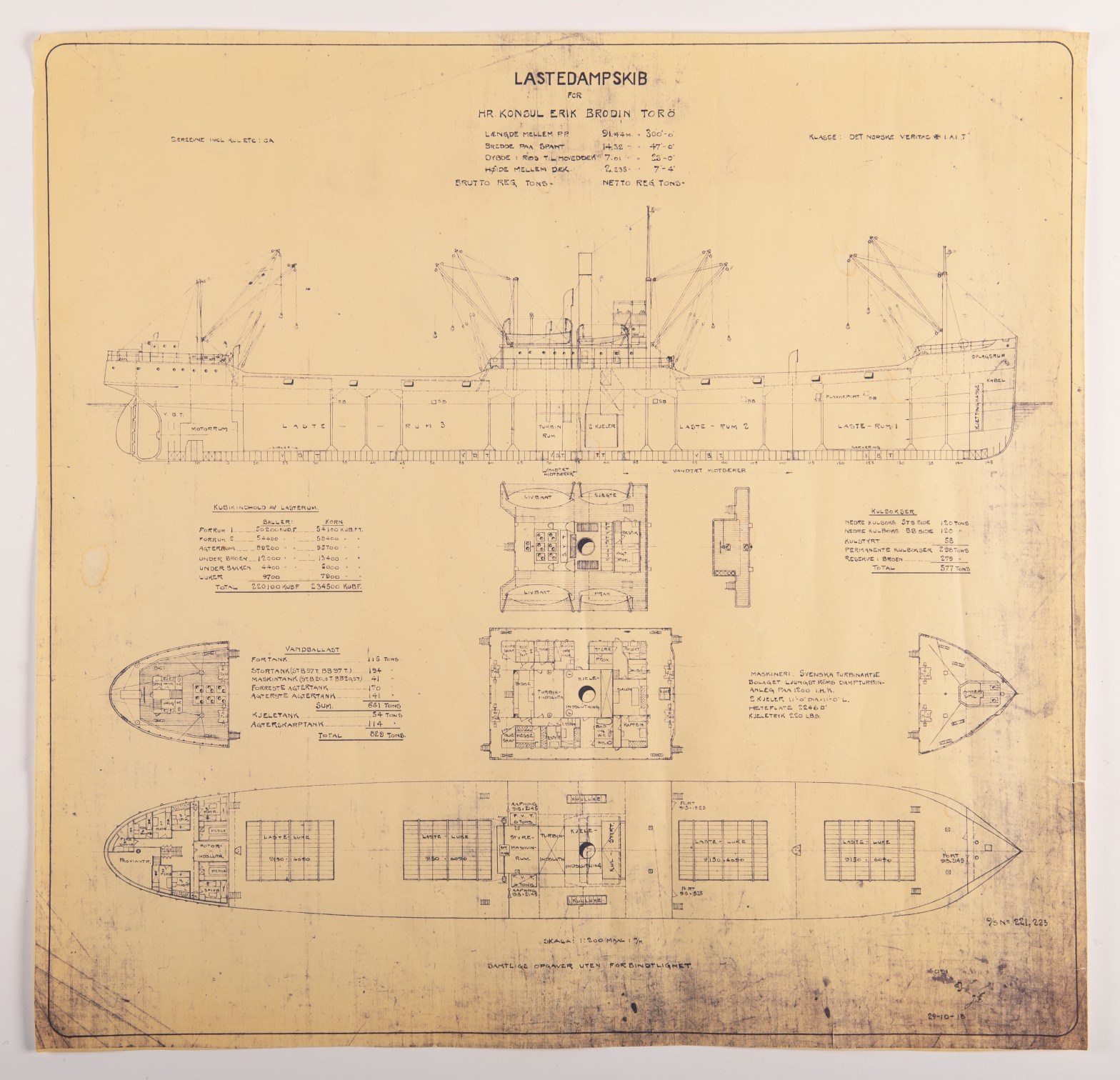
S/S Wanja was built by Fredrikstad Mekaniske Verksted in Norway as build number 223 in September 1919 under the name S/S Aldebaran. She was a typical Fredrikstad style three-island construction, commissioned by Erik Brodins Rederi A/B shipping company from Torø in the Stockholm archipelago in Sweden. She was 300 feet in length, 47 feet wide, had a 21 foot draft and a deadweight (or carrying capacity) of 4,485 tons. She could carry 1,900 tons of cargo. Her maximum speed was nine knots. Of her sister ships Aquila and Arcturus, the latter was most similar in dimensions.
Erik Brodins Rederi went bankrupt in 1921. On 3 December she was taken over by A/B Svenska Handelsbanken, a Swedish Bank, and along with ten other Brodin ships sold to A/S Forenede Rederier (Gørrisen & Co. A/S) in Kristiania, Norway in 1922. The newspapers commented on the sale: «The Norwegian merchant fleet gets a valuable addition».
Gørrisen named her Esther Elina. In 1926 she was reflagged again after being sold back to Sweden and A/B Transmarin and Bernhard Ingelsson in Helsingborg. She was given the name S/S Wanja, the name that history remembers – or should remember – her by.
Ever since the launch Wanja had problems with her main engines. The boilers were constructed at Fredrikstad Mekaniske Verksted, and the engines were supplied by Svenska Turbinfabrikk A/B in Finspång outside Stockholm. During her maiden voyage on 25 September 1919 she had to be towed back to port. These problems continued. She had another engine breakdown in 1923 en route from Cadiz to Buenos Aires. On a journey from Arkhangelsk to Great Britain with timber in December 1924, she ran aground and the bow was damaged and took in water. Another accident occurred on a journey from Florida to Malmö. Her rudder broke and she drifted for six days before the rescue ship Zwartezee reached her. Before putting her to work, the new owners took her to Lindholmens Mekaniska Verkstad A/B in Gothenburg for necessary repairs and to change her engine. A new 3-cylinder steam engine with a capacity of 267 horsepowers was installed in 1926. The new engine was delivered by A/B Lindholmen Motala in Gothenburg, and the new boilers came from North Eastern Marine Engineering Co. Ltd in Sunderland, England.
The plans for S/S Aldebaran reside in the archives of Fredrikstad Museum, including the blueprint pictured here. Remains of her wreck still rests on the reef where she ran aground in 1939, and several items from the ship have been salvaged. Tools originating from the ship are still in use on Sanday, Orkney to this day. More are reappearing as this story develops.
Illustration: Plans for cargo ship Aldebaran (later Wanja), Fredrikstad Museum
 X marks the spot