
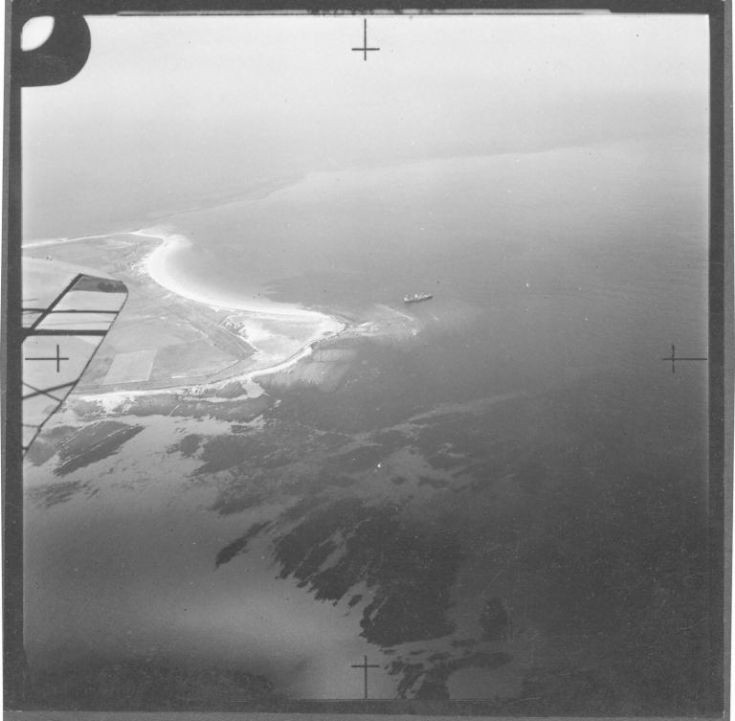
15 October 1939: The ship was not in immediate danger, but was stuck on the rocky reef on Whitemill Point. The crew was safe and unharmed and remained onboard to try and refloat their vessel.
Early in the morning the day after the grounding, a Prize officer and a couple of crew rowed ashore to notify local radio operators and get a message to Kirkwall. Several such messages were sent ashore to the local radio operator to notify authorities, and the reply was that the message had been sent. However, no help arrived.
Local speculations about this foreign ship were already going around. Had she been arrested? Why were there armed Navy guards onboard? Had the ship been run ashore deliberately? Keep in mind this was the local population´s first meeting with a seized ship, and they had no way of knowing that diversion to Kirkwall for contraband control was standard operating procedure for the Royal Navy Northern Patrol. In practical terms, Wanja brought the war to Sanday for real. Despite this scepticism, the Wanja crew were treated to some warm Orkney hospitality, and local islanders brought them soup and tea.
On the 16th, a minesweeper out on patrol stopped, anchored, and put an officer onboard who enquired if they could be of any assistance. When he learnt that Wanja had been aground for almost two days and no assistance had arrived, he then went ashore to notify authorities. It turned out authorities in Kirkwall had not been notified, and Wanja on the reef had only been observed by a plane earlier that same day, who had reported that a Finnish ship had run aground on Sanday. The crew of the Wanja had spotted a plane overhead on that same morning.
Tugboats arrived from Kirkwall, and in the next days repeated attempts were made to refloat the vessel, but Wanja was stuck. The prize crew seemed satisfied to be done with their job and left on a tugboat at the first possible opportunity.
To try and make the ship lighter in weight and refloat her, the crew constructed a winch system from meat barrels and ropes to unload the phosphate manually. This operation continued until the 22nd, at which point they had unloaded 905 tons by hand. Wanja was still stuck.
On the 18th, the British Customs arrived for tobacco and liquor control. According to local reports, the customs men impounded some tobacco and spirits and filled in a report on the grounding. Two local men had taken the customs officers out to the ship and were each rewarded with a bottle of whisky…
Chief Engineer Birger Ericsson had 25 years of service at sea, several of those onboard the Wanja. The ship´s engine logs tell of his dedication to his work. In the days after the grounding, he kept maintaining the engine room onboard, and on 17 October – 3 days after the grounding – he was «Working on painting and improving the engine room». This is a reminder that these ships were not only a place of employment, but the actual home of the crew.
Chief Engineer Ericsson also maintained records of the weather. Mostly he reported “beautiful weather” from the engine room. However as the weather changed, so did the conditions for the crew and hope of refloating the Wanja.
Weather conditions were worsening, and both the sea and the wind took its toll on the ship. On 23 October Wanja´s officers decided to abandon ship. The deck was bending, nails were popping out, the heating stopped working, the pumps stopped working, and water was flowing in. Provisions had run out. They had done what they could.
Johan Emil and his crew mates did not get to bring any of their belongings with them when they left the ship. Since they were onboard from the 14th to the 23rd, close to dry land and with ample time to pack a bag, this did not make sense until stories of their abrupt departure were uncovered.
The lifeboats could not be launched due to the rough weather and the ship´s location on the reef made it impossible for the British patrol boat assisting in the evacuation to get close. The crew attached a line on land, and in groups of four, the crew pulled themselves to land in a small dinghy. Soon after the Captain left the ship as the last man, the ship broke in two. The crew rowed from the beach to the patrol boat and left Sanday and Wanja behind. But their ordeal at sea was not over.
Photo: RAF
 X marks the spot