The patrol boat did not take the soaking wet crew directly to Kirkwall; they first had to come along on a 14-hour patrol. Once in Kirkwall, the Wanja crew were accommodated in the Old Town Hall, where they experienced simple conditions but true Orkney hospitality and warm food. They were safe, dry and no longer hungry but their journey was still not over.
Kirkwall was buzzing with navy activity, ships and sailors. Many of these merchant sailors were never destined for Orkney, but the war had landed them there, with or without their ships.
On 14 October – the date of the attack by U-47 on Scapa Flow and HMS Royal Oak, and the same day the S/S Wanja ran aground on Sanday – another ship met its fate further out into the Atlantic Ocean. S/S Lorentz W. Hansen from Bergen was en route from Canada to Garston, England. The crew had prepared for their Atlantic wartime crossing by turning the lifeboats outwards and equipped them with provisions. The ship´s name, home nation and the Norwegian flag had been painted on both sides of the ship. On 14 October, S/S Lorentz W. Hansen was stopped by a German warship off the coast of Newfoundland.
The crew was ordered to abandon ship and make their way over to the German warship. The warship then proceeded to fire at the Norwegian merchant ship until it started sinking. Crew members testified in the maritime enquiry that the Germans had placed explosive devices onboard. They tried to avoid using torpedoes as those were scarce. Yet the Kriegsmarine were forced to launch one, as the cargo of timber kept the Lorentz W. Hansen afloat.
The Norwegian sailors were held below deck. The German warship´s crew had attempted to cover up any identifying marks and keep the ship´s name hidden. The Norwegian crew was still able to discover that they had been brought onboard the Deutschland. Later the same day, the Deutschland came across Norwegian merchant ship M/V Kongsdal. It is possible that the presence of the Lorentz W. Hansen crew saved the Kongsdal from a similar fate. The Kriegsmarine ordered Kongsdal to take the Lorentz W. Hansen crew onboard, and let them go. Kongsdal proceeded towards Europe. She was then stopped by a British Royal Navy Northern Patrol ship, and Kongsdal diverted to Kirkwall, where she arrived on 21 October.
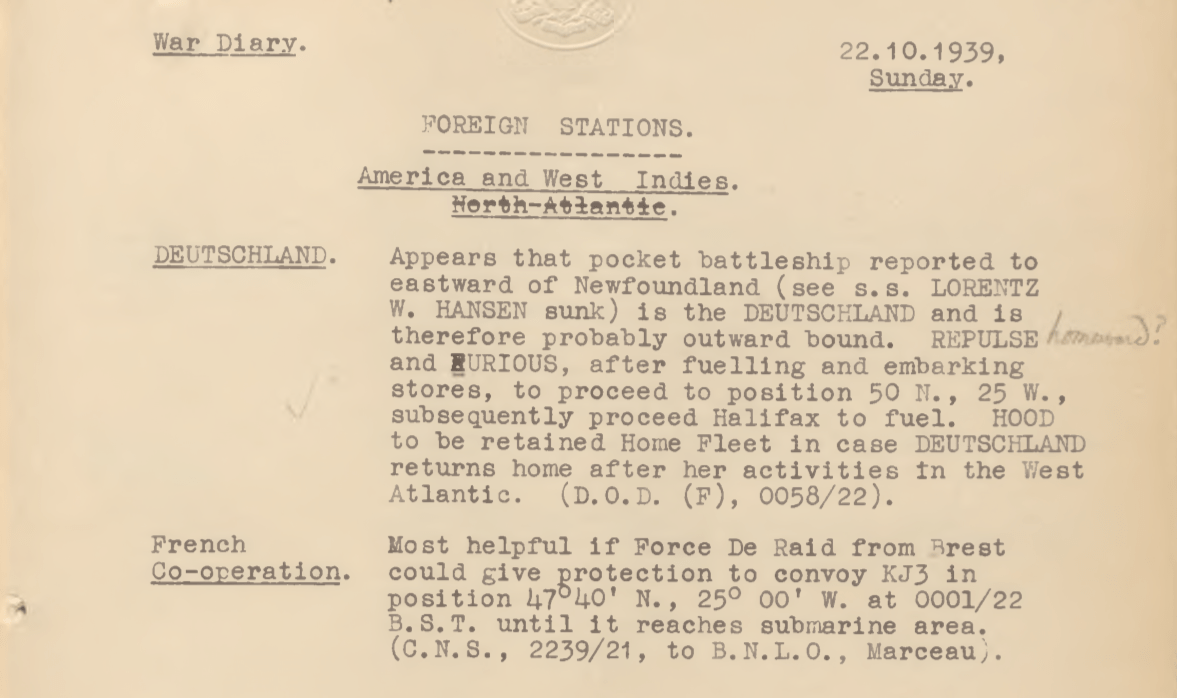
This is how the crew of Lorentz W. Hansen came to be in Kirkwall at the same time as the crew of Wanja. The sailors from Lorentz W. Hansen brought crucial information to the British Admiralty. Up until that time they had operated with information of one single heavy cruiser – or pocket battleship – operating in the North Atlantic, the Admiral Scheer. Now they had confirmation that the Deutschland was also operating in these waters, and could adjust their strategies accordingly.
M/V Kongsdal had landed one shipwrecked crew only to have to give a ride to another one, later in this story… She went on to have an impressive wartime career, and rescue more shipwrecked crews.
Image: Royal Navy War Diary, excerpt from 22 October 1939
 X marks the spot