
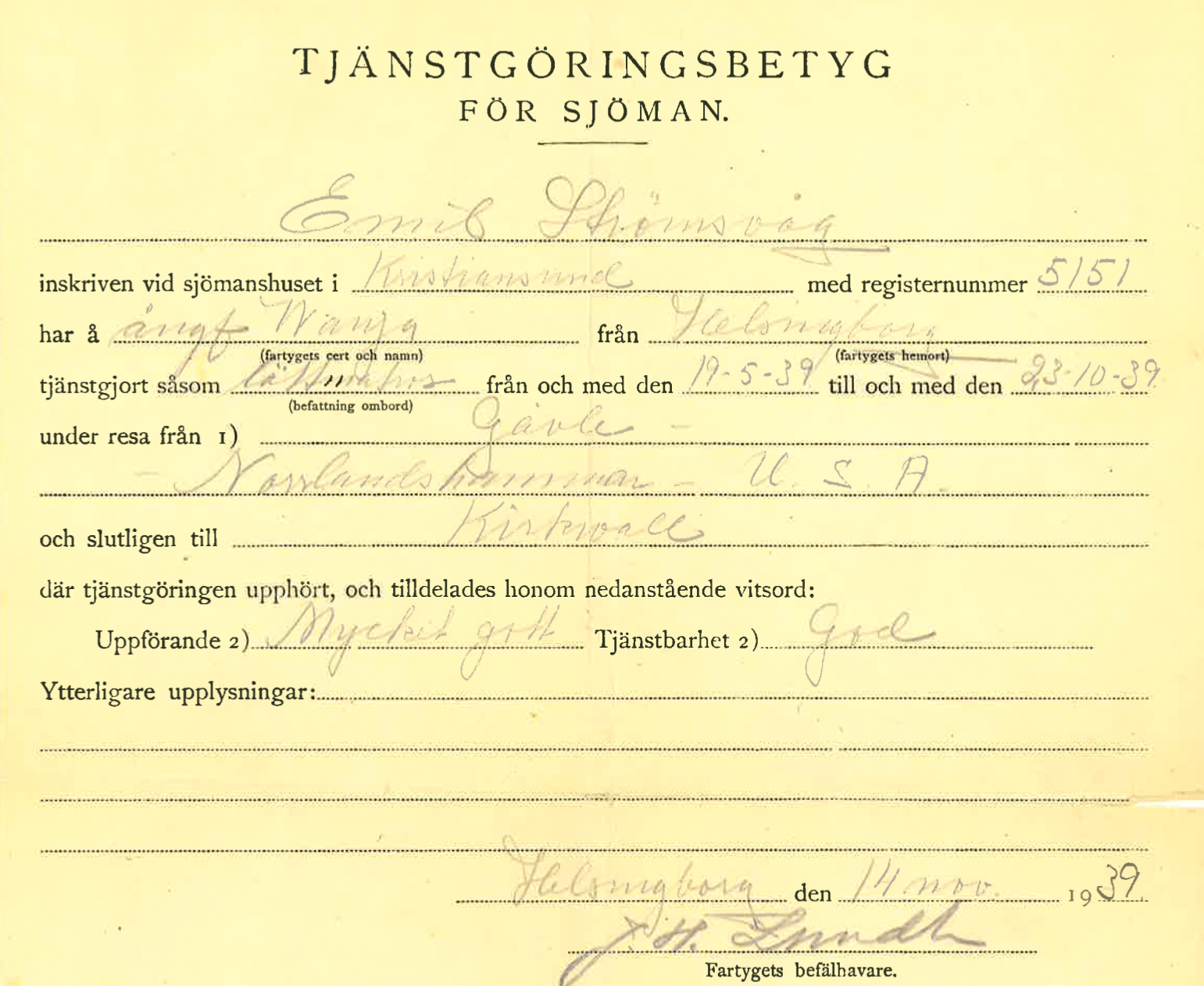
Late October 1939: At this point, there was a substantial number of Scandinavian ships and sailors in Kirkwall that were not originally destined to be there. Some had been diverted with or without Royal Navy prize crews onboard. Others had ended up there without their ships, shipwrecked, like the Lorentz W. Hansen crew. Kirkwall was a hub of naval activity and information.
The crew of Wanja are listed as discharged in Kirkwall on 23 October 1939. There were repatriated on two Swedish ships.
M/V Bardaland was in Kirkwall after having landed 90 rescued sailors from the torpedoed S/S Clan Chisholm. The British Clan line ship was sunk by the U-48 off the coast of Cap Finisterre, northern Spain, on 17 October. Most of the crew had managed to get in the lifeboats, and they drifted for three days before Bardaland could come to the rescue. Bardaland was en route from Haifa via Gibraltar to Gothenburg. Whilst in Kirkwall, she picked up 17 of the 26 Wanja crew and landed them in Oslo on 29 October. Oslo´s largest newspaper Aftenposten printed an interview with one of the crew members, who shared further details of a dramatic ordeal. After 9 weeks en route from Florida they were almost home.
Bardaland, a Swedish Orient Line ship built 1936, went on to have quite the career during WWII: In September 1941 she was tasked with transporting 11,000,000 dollars worth of gold bullion from the Soviet Union to the US in preparation for increased purchases. From August 1942, she was in the service of the Swedish Red Cross, transporting supplies from Canada to a starving Greek population.
S/S Valencia was in Kirkwall for unknown reasons. Perhaps she had also been diverted; this has yet to be confirmed. Valencia had an irregular story from the beginning. She was constructed from leftover materials at a Swedish shipyard in 1925. In 1934 she collided with a British steamer off Lisbon, but survived. In 1937-38, during the Spanish civil war, Valencia was hijacked – and released – 4 times. Eventually she could no longer be saved, when she hit a mine off the coast of Sjælland in 1942 and sank, whilst the crew was rescued by Swedish S/S Algeria. In October 1939 she brought six of the crew from the Wanja back home to Sweden. The Master, Chief Officer and Chief Engineer stayed behind a little longer to complete the formalities in connection with the loss of the ship.
On 26th October 1939, Anna had heard on the radio in Norway that the S/S Wanja was lost, but that the crew were saved. She wrote to her son Johan Emil «Come home now». The letter was sent, but was not delivered until 1946. In the meantime, Johan Emil had indeed come home.
The crew had little opportunity to bring their belongings with them, given their abrupt departure from the ship. Once back in Sweden, they received new clothes and equipment from the shipping company.
And so it came to be that late in 1939, Johan Emil returned to his home town Kristiansund, on the west coast of Norway, speaking a little foreign after having been on Swedish ships for 3 years, and wearing brand new clothes from the big city. Such things do not go unnoticed in a town the size of Kristiansund. Some people, including his future wife, thought he was arrogant and foreign. Noone believed he had seen the war up close. A few months later – in April 1940 – the entire town was decimated by German bombing raids, and only then did war actually arrive on Norwegian land.
 X marks the spot